Buy Art in Bern That Gives Back: CHF 5 to übrig
Buy art in Bern and feed someone too: CHF 5 from every original linocut goes to the Bern association übrig. Why five francs, and where the money goes.
Five francs. In some Bern institutions, that really does buy one portion of food. A whole, warm plate.
That’s why CHF 5 from every original linocut you buy from me goes to übrig, an association here in Bern. If you want to buy art in Bern and have it do a little good beyond your wall, this is my honest answer. And so it’s said upfront: I co-founded übrig.
Why exactly five francs?
I could have picked a percentage. Percentages sound big and mean very little.
Five francs is something you can picture. It’s roughly what a portion of food costs in some Bern institutions. So a sheet I rub by hand with a bamboo baren turns into a meal for someone in the same city. That’s all the maths I need.
The money comes out of my sales revenue. You don’t pay a centime more, and there’s no box to tick at checkout.
To be honest, five francs won’t save the world. But each original only goes out 30 times before I cut the plate into pieces. Each of those 30 sheets carries one plate of food with it, and I like that better than a big promise.
What is übrig, and what happens to the money?
übrig is a Bern association with a simple idea: whatever a kitchen has left after service should go on safely instead of into the bin. I built the tool in Bern together with volunteers.
It works in four steps:
- Check: the kitchen answers seven hygiene questions. Only if every answer is yes does anything leave.
- Report: what it is, how much, and when and where it can be collected.
- Label: goes on the container, same layout every time.
- Log: stays in the browser, so both sides know what was handed over and when.
No account, no server. Social institutions order what has been released, and a courier on a cargo bike brings it over, usually the same evening. That’s the plan. The pilot hasn’t started yet, so no cargo bike is carrying food across Bern right now. I’d rather say that plainly than dress it up.
There’s a line on the übrig site I like: “Ein Abend übrig kostet elf Franken”, one evening of übrig costs eleven francs. That’s what a carvelo2go e-cargo bike costs for three hours, one collection round. Two originals sold almost cover a whole evening.
Food waste, art and neighbours: what else Bärn Kit does
Around übrig, Bärn Kit has grown: a set of small, free tools for Bern. No account, no tracking. Two of them are close to my heart.
Kunst in Bern: the street as a gallery
The map Kunst in Bern shows 493 public artworks plus 52 galleries and museums, built on the City of Bern’s open data. One button finds the closest work and the walking route there.
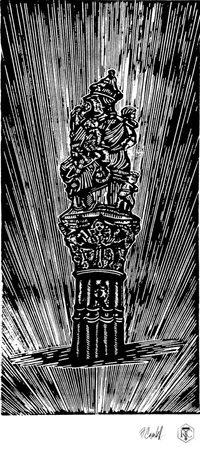
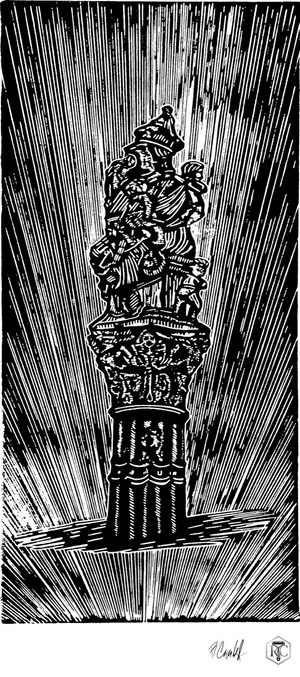
For someone who cuts linocuts, it’s almost a sketchbook. The Child-Eater on Kornhausplatz, which became my print The Fountain, has its own page there too. The story behind it is in my piece on Bern’s fountains and the Child Eater.
Neighbourhood help: the help board and the stairwell note
The help board has a three-word tagline: ask, help, lend. Next to it there’s the Treppenhaus-Zettel, a stairwell note for your building. At the top: “I can help with …”. Below: “I could use help with …”. You tap what fits, print it on A4 and pin it up in the stairwell.
The note comes in five languages, including Ukrainian and Slovak, and your details never leave your device. To me it’s the analogue cousin of a print on the wall: paper that brings people in the same building together.
Does this apply to the 3D models too?
Yes. From 1 December 2026, CHF 5 from every 3D model sold also goes to übrig. Why a linocut studio suddenly makes buildings in 3D is in the article from linocut to 3D model.
Zytglogge, Minster, Federal Palace: they’re the same buildings I otherwise cut in lines. Letting them carry a few meals as well didn’t take much thinking.
Buying art that gives something back
I make linocuts because cutting calms me down. Every line is final, a cut can’t be taken back. That fits übrig somehow: food that has been cooked shouldn’t just disappear.
When you buy an original, you hang a piece of Bern on your wall. And somewhere in the same city, a plate of food gets paid for.
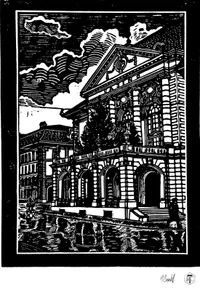
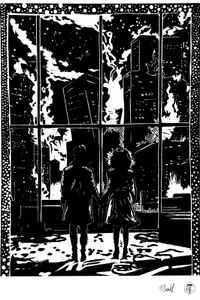
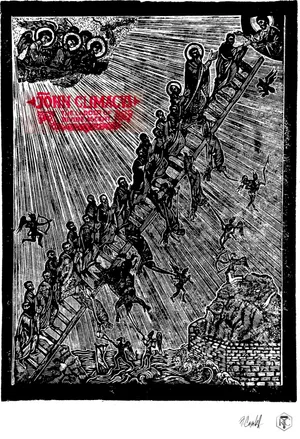
If you’re looking for one, have a look at The Ladder or all originals. And if you’re curious how a drawing turns into all those fine cut lines, read the piece about the lines.
Prints in this article
Questions
How much of each original goes to übrig?
CHF 5 from every original linocut sold goes to the Bern association übrig. From 1 December 2026 the same applies to every 3D model. It comes out of my sales revenue, so you don't pay anything extra.
What does übrig do?
übrig builds a free browser tool that lets kitchens pass on cooked leftovers safely to social institutions. It also runs Bärn Kit, a set of free tools for Bern such as the art map Kunst in Bern and a printable stairwell note for neighbourhood help.
Are the cargo-bike deliveries already running?
Not yet. The tool exists, but the pilot with kitchens, institutions and the cargo bike has not started.